National Level Hybrid Talk on Indian Knowledge Systems
INTRODUCTION
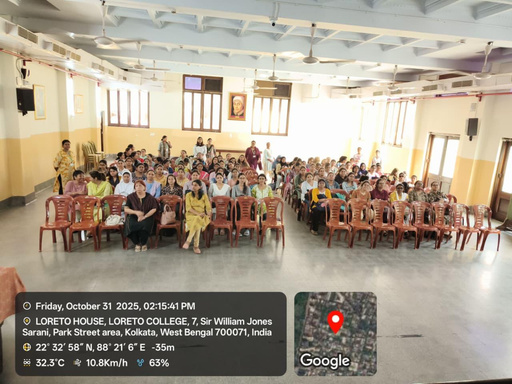
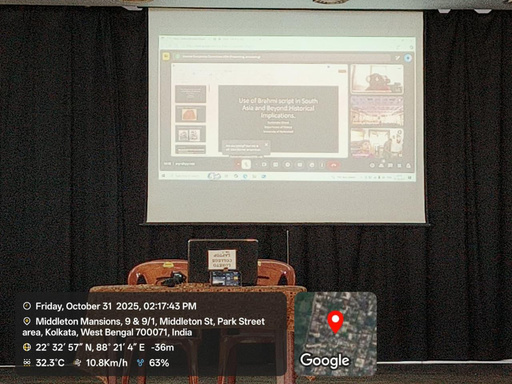
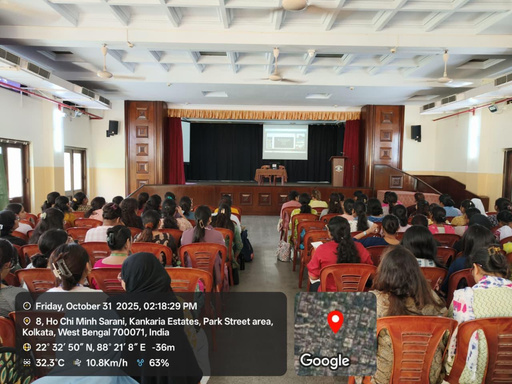
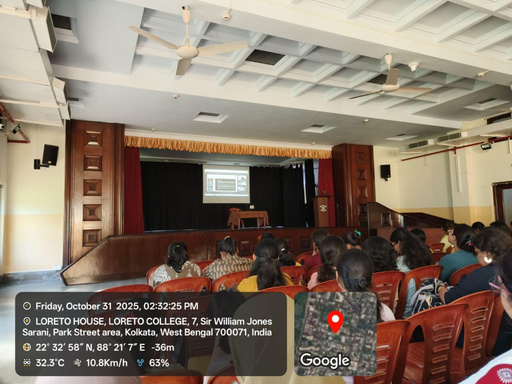
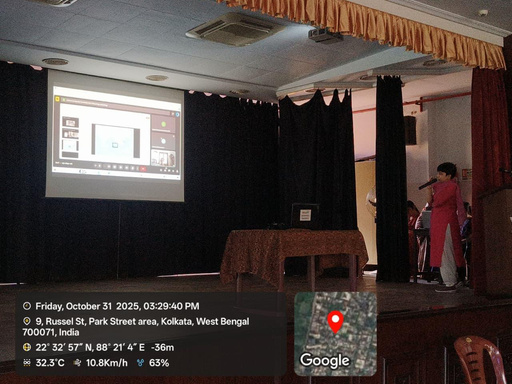
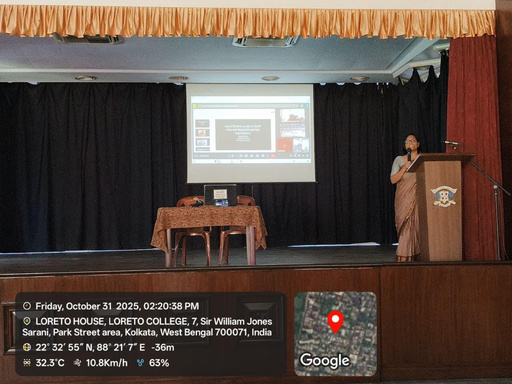
On 31st October 2025, the Department of B.Ed and Education, in collaboration with IQAC, organized a workshop at Loretto College Auditorium with Dr. Suchandra Ghosh, Professor of History, University of Hyderabad. The session introduced the evolution of Indian scripts.
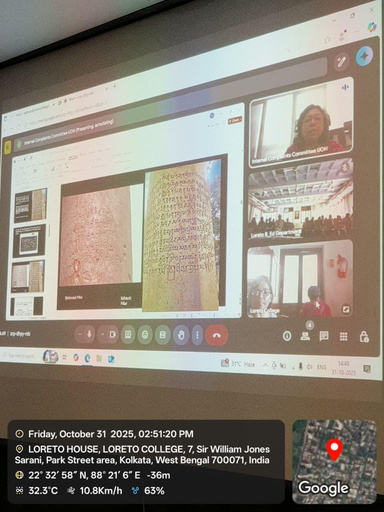
India, a multilingual country, has a long history of diverse writing systems. The earliest major script, Brahmi, is seen in the inscriptions of King Ashoka. In the post-Ashokan period, sites like Sanchi show changes in letter forms and emerging regional variations. By the Gupta period, Brahmi developed into more rounded and stylized forms, later giving rise to scripts such as Devanagari.
In South India, by the 6th century CE, distinct regional scripts appeared across the Tamil region and the Deccan Plateau. Despite variations in form, the tradition of writing continued uninterrupted, shaping the script heritage of the subcontinent.
This very insightful lecture on understanding the influence of Indian languages on South East Asia was indeed very delightful .
PERFORMANCE OVERVIEW
The students actively participated in discussions, presentations, and analyses of inscriptions from the Ashokan, Sanchi, and Gupta periods.
They observed how letter forms evolved, how languages shifted from Prakrit to Sanskrit, and how regional scripts developed from a common origin.
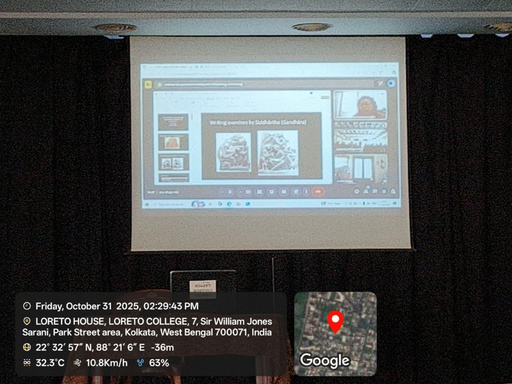
The session also included visual aids and examples of inscriptions, enabling students to connect historical evidence with linguistic evolution.
Overall, the programme demonstrated a strong understanding of how India's multilingual character shaped its scriptural diversity and cultural continuity.
KEY PERSPECTIVES
1. India's Deep-Rooted Multilingual Identity
India's linguistic diversity was presented not as a modern occurrence but as an intrinsic civilizational characteristic spanning millennia.
The coexistence of multiple language families-Indo-Aryan, Dravidian, Tibeto-Burman, and Austroasiatic-reflects India's layered cultural evolution.
The lecture highlighted how multilingualism fosters cultural exchange, innovation, and regional identity formation.
2. The Central Role of Brahmi as the Foundation Script
Brahmi was positioned as the earliest and most influential script of the subcontinent, forming the base for many modern Indian scripts.
Its adaptability to regional phonetics was emphasized as a key reason for its widespread evolution and longevity.
Brahmi inscriptions (e.g., Ashokan edicts) were used to demonstrate its early standardized form and communication power.
3. Emergence of Devanagari and Its Intellectual Significance
The discussion traced how Devanagari evolved from earlier Brahmi forms through Gupta and Nagari scripts.
Its scientific structure-clear vowel signs, distinct consonant forms, and phonetic precision-was highlighted.
The wide usage of Devanagari for Sanskrit, Hindi, Marathi, Nepali, and several classical texts showcases its scholarly and cultural authority.
4. Regional Variation: Scripts as Cultural and Functional Adaptations
A key perspective was how scripts changed across regions in response to social needs, state sponsorship, artistic styles, and technological shifts (e.g., palm-leaf manuscripts).
Examples included:
Tamil and Grantha adapting to Dravidian phonetics,
Bengali-Assamese adopting a rounded style,
Gurmukhi emerging to preserve Sikh teachings,
Kannada and Telugu developing curves suited for palm-leaf writing.
These variations demonstrate that scripts are living systems shaped by people, usage, and context-not static forms.
5. Language and Script as Expressions of Identity
The lecture emphasized that scripts often carry cultural memory, religious significance, and regional pride.
Changes in script forms mirrored political shifts, cultural renaissance movements, and educational reforms.
6. Influence of Indian Scripts Beyond the Subcontinent
A major perspective was India's script-based cultural outreach to Southeast Asia.
Through trade, religion (especially Buddhism and Hinduism), and scholarly transmission, Brahmi-derived scripts influenced:
Khmer (Cambodia)
Thai (Thailand)
Lao (Laos)
Javanese & Balinese (Indonesia)
Burmese (Myanmar)
These scripts show structural similarities-such as syllabic patterns and vowel markings-revealing India's historical role as a civilizational hub.
7. Dynamic Evolution of Scripts with Changing Times
Scripts evolved in response to societal needs: administration, literature, religion, technology (printing, digital fonts).
The fluidity of Indian scripts reflects a tradition of innovation and adaptation within Indian Knowledge Systems.
8. Integration of Linguistic Heritage in Contemporary Education
The lecture underscored the importance of reconnecting with India's linguistic past to strengthen cultural literacy.
Understanding script evolution fosters appreciation for diversity, inclusivity, and historical continuity-key aims of IKS-based education.
CONCLUSION
The lecture on Indian Knowledge Systems offered a comprehensive understanding of India's linguistic richness and the remarkable evolution of its scripts. By tracing the journey from the early Brahmi script to the diverse regional scripts and the refined structure of Devanagari, the session highlighted how India's writing traditions have continuously adapted to cultural, technological, and societal shifts. The discussion on India's multilingual nature further reinforced that linguistic plurality is not merely a feature of the nation, but a defining aspect of its civilizational identity.
Moreover, the exploration of how Indian scripts influenced Southeast Asian writing systems revealed India's far-reaching cultural impact across Asia. Overall, the lecture successfully demonstrated that Indian scripts are not isolated alphabets but living embodiments of history, thought, artistic expression, and intercultural exchange. Recognizing and appreciating this heritage deepens our understanding of India's knowledge traditions and encourages continued preservation and study of its linguistic legacy.
|




 ANNOUNCEMENTS