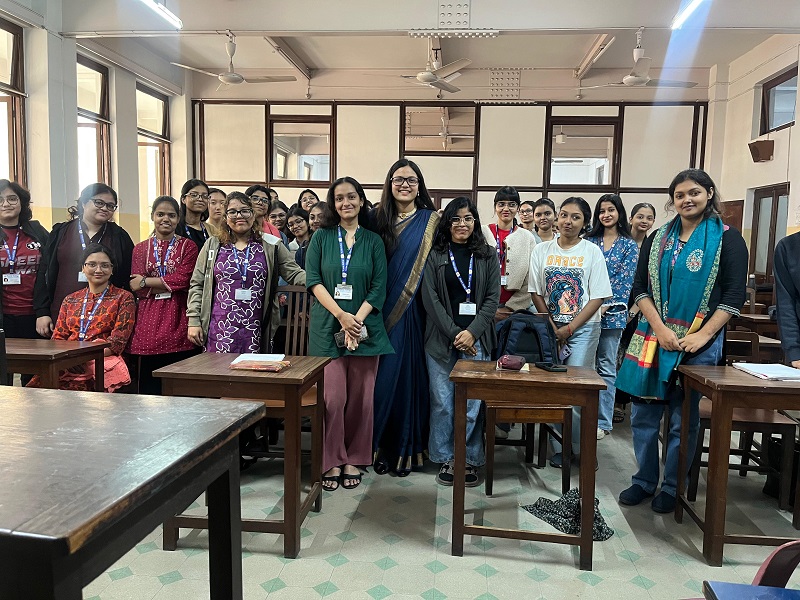
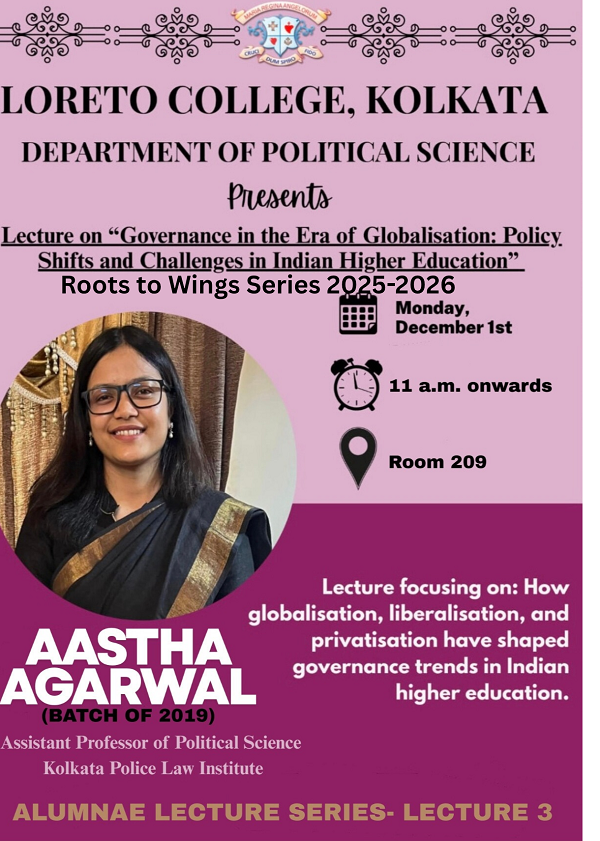
Alumnae Lecture Series 3 by Ms. Aastha Agarwal Organized by the Department of Political Science
The Department of Political Science, Loreto College, Kolkata, organized a special lecture titled "Governance in the Era of Globalization: Policy Shifts and Challenges in Indian Higher Education" on 1st December at 11:00 a.m. The session was delivered by Ms. Aastha Agarwal, Assistant Professor of Political Science at the Kolkata Police Law Institute and PhD Scholar at the West Bengal National University of Juridical Sciences (WBNUJS). A distinguished alumna of the College, Batch of 2019, Ms. Agarwal brought with her a strong academic grounding and research expertise in governance and public policy, which enriched the discussion.
Ms. Agarwal opened the lecture by clarifying the fundamental distinction between government and governance, highlighting how the latter today involves a wide network of actors-researchers, NGOs, academics, bureaucrats, students, and even social media influencers whose narratives increasingly shape public policy.
She discussed the impact of digitalization on governance, drawing attention to the persistent infrastructural challenges that are particularly visible within Indian higher education institutions. Connecting past and present, she also reflected on British governance in India, noting its emphasis on centralized authority, executive dominance, codified legal structures, and an administrative system oriented towards control rather than welfare.
Ensuring an interactive environment, Ms. Agarwal engaged students through relatable examples, memes, and real-life incidents, making complex political concepts accessible and stimulating active participation throughout the session.
Her presentation further traced major shifts in India's governance-from early socialist planning and the License-Permit-Quota regime to the transformative 1991 LPG reforms-and explained how these transitions continue to influence the structure and functioning of higher education today.
The lecture concluded by encouraging students to critically examine how globalization is reshaping higher education governance, especially in terms of autonomy, access, equity, and the evolving role of the state.
The session proved to be deeply enriching, successfully blending historical perspective with contemporary policy analysis, and was highly appreciated by the students of the department.




 ANNOUNCEMENTS